


Table of Contents

Table of Contents
Most conversations about law firm marketing start at the top. More traffic. More leads. More ads. More visibility. Those things matter, and they get most of the attention. But here is the part that quietly decides how much a firm actually grows, and it’s the part almost no one is watching: what happens after the phone rings in a marketing service.
You can run great campaigns, rank well in search, and fill the calendar with inquiries, and still end the month feeling like the growth does not add up. When that happens, it’s tempting to assume the marketing is broken and to go looking for more leads. Sometimes that is the right call. More often, the problem is not at the top of the funnel at all. It’s in the handoff. The minutes after a lead reaches out. The quality of that first conversation. The follow-up that keeps a good opportunity alive long enough to become a client.

That is the missing link. It sits between the marketing you are already paying for and the signed clients you actually want, and for a lot of firms, it’s wide open. The encouraging part is that this is also the most fixable part of the entire system, and the part that gives you the fastest return, because you are not buying more attention; you are finally capturing the attention you already earned.
The Missing Link Isn’t More Leads
Here is a reframe worth sitting with for a moment. Marketing’s job is to get the right person to raise their hand. Intake and follow-up determine whether that person becomes a client. Those are two different jobs, and a firm can be excellent at the first and quietly lose at the second without ever realizing it.
Picture two firms in the same city, practicing the same kind of law, spending the same budget, and generating the same number of leads each month. One firm answers fast, runs a confident first conversation, and follows up until it gets a clear yes or no. The other lets calls go to voicemail during busy stretches, handles the first conversation differently depending on who picks up, and rarely follows up more than once. Same marketing. Same leads. Wildly different revenue at the end of the year. The difference was never the marketing. It was the conversion engine behind it.
This is good news, because it means growth is not always about spending more at the top. Some of the biggest and cheapest gains a firm can make are sitting in the middle of the funnel, in the leads it has already paid to attract. When you tighten the connection between marketing and the front office, the same lead flow starts producing more signed clients without a single additional dollar of ad spend. That is the kind of growth that compounds, because it makes every future marketing investment more profitable too.
Where Law Firms Actually Lose Leads
When a qualified lead does not turn into a client, it rarely fails for one dramatic, obvious reason. It usually fails in small, ordinary moments that nobody is tracking and nobody feels responsible for:
- A call comes in during a busy stretch, goes to voicemail, and the callback happens hours later, after the prospect has already spoken with another firm.
- The first conversation is pleasant but unstructured, so the prospect hangs up unsure of what the firm does next or what they are supposed to do next.
- A prospect says they need to think it over, and because no one owns the follow-up, no one ever reaches back out.
- A web form lands in an inbox or a CRM, gets glanced at, and quietly goes stale beneath the next thing.
- An after-hours inquiry never gets a same-day response, and by morning, the momentum is gone.
None of these feel like emergencies at the moment. That is exactly why they are so dangerous. Each one is a small leak, easy to overlook on any given day. Added up over a quarter or a year, they are often the entire difference between a firm that feels stuck and a firm that feels like it’s finally pulling ahead.
It’s worth saying plainly: these are not talent problems. The people answering your phones are usually capable and well-intentioned. They are operating without a process, without clear ownership, and without the tools to make the right action the easy one. That is a fixable situation, and fixing it does not require hiring differently or working harder. It requires building the structure that lets good people do their best work consistently.
How Fast Should A Law Firm Respond To A New Lead?
As fast as you reasonably can, and almost certainly faster than you do today. Legal prospects are rarely casual shoppers. They are often anxious, motivated, and dealing with a problem that feels urgent to them, which means they are contacting more than one firm, and they are paying close attention to who treats them seriously first.
The firm that responds first usually gets the first real conversation, and the first real conversation usually gets the best chance at the client. Speed is not only a logistics advantage. It’s a trust signal. A fast, calm, helpful response tells a worried person that this firm is organized, attentive, and capable of handling their matter. A slow response, or no response, tells them the opposite, no matter how strong your actual representation would have been. Prospects cannot evaluate your legal skill from a first phone call, so they judge what they can see, and responsiveness is the very first thing they see.
There is a real cost difference hiding in those minutes. A lead contacted within a few minutes is dramatically more likely to convert than the same lead contacted an hour later, because by then the prospect has often moved on, cooled off, or signed elsewhere. If your team cannot always respond quickly in the moment, and most busy firms cannot, that is precisely the gap between a defined process and the right automation built to close. An instant, genuine acknowledgment buys you time. Silence costs you the case.
What Does A Strong Law Firm Intake Process Look Like?
A strong intake process is not a rigid script read off a card, and it’s not just being friendly on the phone. It’s a repeatable conversation that does a few important things well, every single time, regardless of who happens to pick up or how hectic the day is:
- It builds trust fast. The prospect feels genuinely heard and understood before anything else happens, because that is what earns the right to keep the conversation going. People hire firms they feel comfortable with, and comfort starts in the first thirty seconds.
- It qualifies clearly. The team understands whether this is a fit, what the matter involves, and how urgent it’s, without making the person feel like they are being screened or processed. Good qualification feels like care, not interrogation.
- It guides the next step. The prospect always leaves the conversation knowing exactly what happens next, who will contact them, and when. Ambiguity is where momentum dies.
- It stays consistent. The experience does not swing wildly depending on which team member answered or how busy the office was that afternoon. Consistency is what turns a good intake into a reliable one.
Just as important is what a strong intake process avoids. It does not rush a nervous person through a checklist. It does not leave them on hold with no sense of when someone will return. It does not end without a clear next action. And it does not treat the call as an interruption to the real work, because for that prospect, this call is the real work, and it’s the first true impression of how your firm operates.
When intake is handled this way, your marketing instantly becomes more valuable, because more of the people it brings in actually move forward. You are not generating more leads. You are wasting fewer of them. Same top of funnel, meaningfully better bottom line.
The First Conversation: Connect Before You Convert
There is a reason we talk so much about connecting rather than convincing. The instinct, when a lead comes in, is often to sell, to list credentials, to explain why the firm is the right choice. But a person reaching out about a legal matter is not looking to be sold. They are looking to feel understood and to believe that the person on the other end of the line actually gets what they are going through.
Connection comes first, and conversion follows from it. When a prospect feels heard, they relax. When they relax, they share more, which lets the team qualify the matter accurately and recommend the right next step with confidence. When the recommendation is built on a real understanding of their situation, it does not feel like a pitch. It feels like guidance. That is the entire difference between a conversation that pressures and a conversation that helps, and prospects can tell which one they are in within the first minute.
This is also why the first conversation cannot be left to chance or improvised differently by every team member. The firms that convert consistently have a shared, repeatable way of opening that conversation, building rapport, asking the right questions, and moving toward a clear next step, all while sounding human rather than scripted. That repeatable approach is teachable, and it’s one of the highest-leverage things a growing firm can put in place.
Why Good Leads Still Go Cold: The Follow-Up Problem
Most prospects do not sign on the first contact, and that is completely normal. They get busy. They compare options. They want to talk it over with a spouse or wait for a paycheck or simply sleep on a decision that feels big. A prospect who does not commit on day one has not rejected you. They have just not said yes yet, and the gap between those two things is follow-up.
Here is where a surprising number of firms quietly leave money on the table. Follow-up gets treated as optional, or it depends entirely on whether someone happens to remember. It cannot live in a person’s memory, a sticky note on a monitor, or a vague intention to circle back later. It needs to be a real system, with clear ownership, defined timing, more than one touchpoint, and a way to see what is still open and what has gone quiet.
A prospect who was not ready on Monday may be ready on Thursday, but only if someone is still there on Thursday. The firms that win these opportunities reach out more than once, across more than one channel, in a way that stays helpful rather than pushy. There is a real difference between persistence and pestering, and a good follow-up sequence respects it: each touch adds value, answers a likely question, or makes the next step easier, rather than just asking again. A consistent, respectful follow-up process is one of the highest-return things a firm can build, because it rescues opportunities that are already most of the way to yes and would otherwise vanish in silence.
Qualifying The Right Cases Without Creating Friction
Converting more leads does not mean converting every lead. Part of a strong intake and follow-up process is figuring out, quickly and respectfully, which prospects are the right fit for your firm and which are not. Done poorly, qualification feels like a gatekeeping interrogation that pushes good prospects away. Done well, it feels like the firm is paying careful attention to the person’s situation.
The goal is to protect your attorneys’ time for the matters that fit, while still treating every caller with respect, because today’s wrong-fit caller is tomorrow’s referral source if they were handled with care. A clear qualification approach also makes follow-up smarter. When the team knows which opportunities are strong, it can prioritize them, follow up with the right intensity, and avoid pouring energy into matters that were never going to convert. That focus is part of how stronger intake improves results without requiring more lead volume.
Does A Law Firm Really Need Sales Training?
It helps to set the word “sales” aside for a second and call it what it actually is: helping an anxious person feel confident about taking the next step with your firm. Framed that way, it’s not pushy at all. It’s a service. And like any service, it’s a skill, which means it can be taught, practiced, and made consistent across an entire team rather than left to whoever is naturally good at it.
This is exactly what our Connect Convert methodology is built for. It gives intake and client-facing teams a repeatable way to connect with leads quickly, build genuine rapport, guide the conversation, qualify with care, and move the right prospects toward signing, all without sounding scripted or salesy. It turns the most important conversation in your funnel from something that happens by luck into something that happens by design.
Consider what it means to skip this. A firm invests real money to make the phone ring, then asks the most pivotal moment in the entire process, the live conversation with a ready prospect, to go well on instinct alone. When that conversation is handled inconsistently, the marketing gets blamed for results that were actually lost at the point of contact. Training the people who handle leads is often the single highest-return investment a firm can make, because it lifts the conversion rate on every lead the marketing already produces. A modest improvement in conversion, applied across all of your existing leads, frequently outperforms spending the same money on more leads that hit the same weak process.
The Systems That Make Better Conversion Repeatable
Better intake and follow-up should not depend on heroics or on one especially diligent team member. The firms that convert consistently build a few simple systems around their people so the right thing happens by default:
- A CRM that supports the work, not just stores names. Lead routing, response reminders, clear ownership, and follow-up tasks, so an inquiry is never sitting unowned and nothing slips between the cracks.
- Automation for the predictable parts, like an instant, genuine acknowledgment the moment a new inquiry arrives and timed follow-up nudges for the team, so speed and consistency do not depend on someone happening to be free at that exact minute.
- Tracking that shows the truth, response time, contact rate, consultations booked, show rates, and signed clients by source, so you can see precisely where conversion is strong and where it leaks, instead of guessing.
- Accountability, so the process is genuinely owned and reviewed on a regular rhythm, not just hoped for and quietly abandoned when things get busy.
None of this is about piling on technology or complexity. The opposite, actually. The point of a good system is to make the right action the easy action, every day, so a busy team does not have to rely on memory or willpower to do what matters. When the structure carries the load, good leads stop falling through the cracks, and growth starts to feel predictable instead of lucky.
What Should A Law Firm Measure To Know Intake Is Working?
If you cannot see it, you cannot improve it, and most firms simply cannot see what happens after a lead comes in. Top-of-funnel numbers like traffic and total leads tell you nothing about conversion. The metrics that actually reveal whether intake and follow-up are working live deeper in the funnel:
- Speed to lead: how long, on average, before a new inquiry gets a real response.
- Contact rate: what percentage of inquiries the team actually reaches and has a conversation with.
- Consultation booked rate: how many of those conversations turn into a scheduled next step.
- Show rate: how many booked consultations actually happen.
- Signed rate: how many consultations become retained clients.
- Conversion by source: which marketing channels produce leads that actually convert, not just leads that arrive.
These numbers turn vague frustration into a clear map. They show you exactly where the funnel is leaking, whether the problem is speed, the conversation, the follow-up, or the fit of the leads themselves. And once you can see the leak, fixing it stops being a guessing game. This is the difference between a firm that feels at the mercy of its marketing and a firm that leads it.
The Hidden Cost Of A Weak Front Office
It helps to put a number on this, even a rough one. Say your firm spends real money each month to generate leads, and a meaningful share of those leads never become clients because of slow response, an inconsistent first conversation, or follow-up that stopped after one try. Every one of those lost opportunities carries two costs: the marketing dollars you already spent to create it, and the lifetime value of the client you never signed. The second cost is almost always the larger one, and it’s invisible, which is exactly why it goes unaddressed for so long.
A firm rarely feels these losses as a single painful event. They show up as a quiet, persistent drag, the sense that marketing is expensive and the results are hard to trust. But reframed honestly, a weak front office is often the most expensive line item a firm has, precisely because no one is counting it. The flip side is just as true and far more hopeful: improving conversion even modestly, across all the leads you already generate, can produce more growth than any new campaign, at a fraction of the cost.
How To Tell If Intake And Follow-Up Are Costing Your Firm
You do not need a formal audit to get an honest read. Ask your team a few direct questions and pay attention to how confidently they can answer. Hesitation is the signal:
- How quickly do we respond to a new lead, on average, and who is responsible when the office is busy or it’s after hours?
- Does every prospect leave the first conversation knowing exactly what happens next and when?
- How many times do we follow up before we let a lead go, and is that the same for everyone on the team?
- Can we actually see how many inquiries became consultations and signed clients last month, and from which sources?
If the answers come back vague, uneven, or different depending on who you ask, that is not a reason to feel discouraged. It’s the clearest possible sign of where your next growth is hiding. These are the exact gaps that separate an active marketing program from a predictable one, and they are entirely within your control to close.
How a Marketing Boss Helps Law Firms Convert More Of The Leads They Already Have
We are not a vendor running disconnected tactics. At Marketing Boss, we focus on the part of growth that most marketing never touches: the conversion engine that turns inquiries into signed clients. That means Connect Convert sales and intake training, structured follow-up systems, CRM and automation support, and Fractional CMO leadership that keeps marketing, intake, and follow-up aligned and accountable to the same goal.
We start by helping you see where your leads are actually being lost, then build the process, training, and systems to stop the leaks. The aim is simple and measurable: help your firm turn more of the opportunities you are already creating into booked consultations and signed clients, so the marketing investment you have already made finally shows up where it counts, in revenue and in growth you can predict.
Ready To Close The Gap Between Leads And Signed Clients?
If your firm is getting leads but the growth still feels uneven, the next move probably is not more marketing. It’s a stronger intake and follow-up process behind the marketing you already have, so more of those hard-won leads actually become clients.
Let’s talk about what your firm could convert with the lead flow it already has. Call 404-751-3594 or visit marketing-boss.com to start a strategy conversation.
Final Thought: Grow With The Leads You Already Have
It’s easy to believe that the growth path always runs through more, more traffic, more ads, more leads. Sometimes it does. But for a firm that is already generating inquiries, the faster and far cheaper path usually runs through better. A quicker response. A stronger first conversation. Follow-up that does not quit after one try. Systems that make all of it consistent.
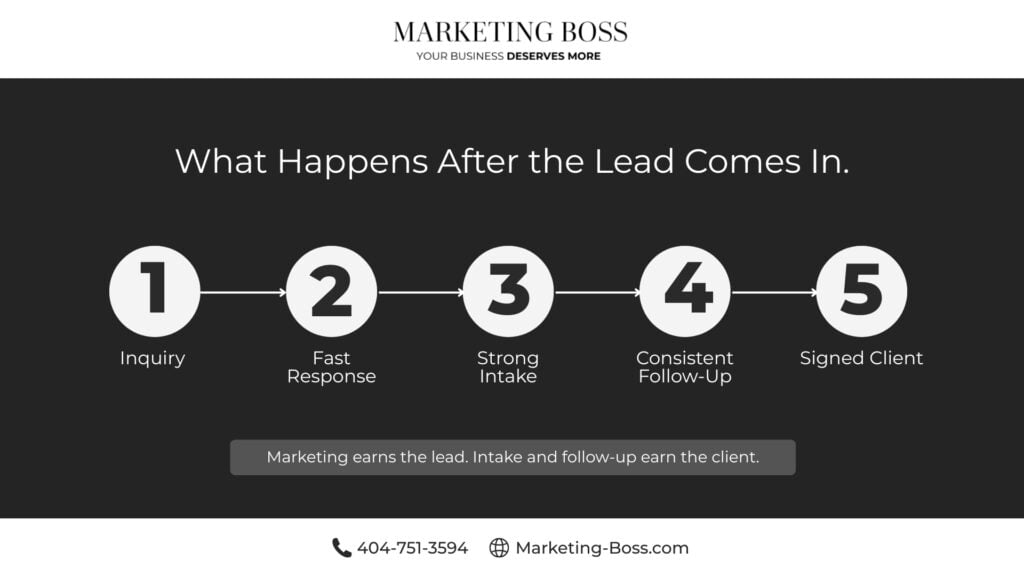
Marketing earns the lead. Intake and follow-up earn the client. When those two halves finally work together, your marketing stops feeling like a gamble and starts feeling like a system you can lead with confidence, and your firm starts converting the opportunities it has been creating all along.
Frequently Asked Questions
As quickly as possible, ideally within minutes. Legal prospects often contact more than one firm and decide quickly while they are motivated. A fast, calm response builds trust and protects the opportunity, while delays hand the first real conversation to a competitor.
Speed to lead is how long it takes to respond to a new inquiry. It matters because prospects are comparing firms in real time, and the one that responds first usually earns the first conversation. Faster response also signals that the firm is organized and takes the matter seriously, which builds trust before any legal work begins.
It builds trust quickly, qualifies the matter clearly, guides the prospect to a defined next step, and stays consistent no matter who answers or how busy the day is. A good intake process feels like attentive service, not a script or a screening call.
Respond faster, give the team a repeatable way to handle the first conversation, qualify with care, always set a clear next step, and follow up consistently. Then track where prospects drop off so you can fix the specific weak point instead of guessing. Training, such as Connect Convert, makes these improvements consistent across the whole team.
Usually because follow-up is inconsistent. Most prospects do not sign on first contact, so opportunities need more than one touch over time. Without a defined follow-up system, ready-to-sign prospects slip away simply because no one reached back out at the right moment.
Connect Convert is Marketing Boss’s sales and intake training methodology built for law firms. It gives client-facing teams a repeatable way to connect with leads, build trust, qualify clearly, and convert more qualified inquiries into signed cases, by connecting with people rather than pressuring them.
Look beyond traffic and total leads. Track speed to lead, contact rate, consultation booked rate, show rate, signed rate, and conversion by source. These funnel metrics reveal exactly where opportunities are being lost and where to focus.

Written By Margarita Eberline
At Marketing Boss, I help law firms like yours simplify, systemize, and scale their marketing efforts. Early in my career, I took on a sales role at Telemundo Atlanta, where I connected with local attorneys and was inspired to launch my own full-service advertising agency. Over the years, I realized that the traditional agency business model was fundamentally incompatible with my desire to remain fully tactic-agnostic and data-driven in my recommendations to clients. This led me to launch Marketing Boss, where I could focus on creating unbiased strategies that serve my clients’ needs.
Insights from the Marketing Boss Team


Your Firm Deserves Marketing That Works

Your Firm Deserves Marketing That Works