


Table of Contents

Table of Contents
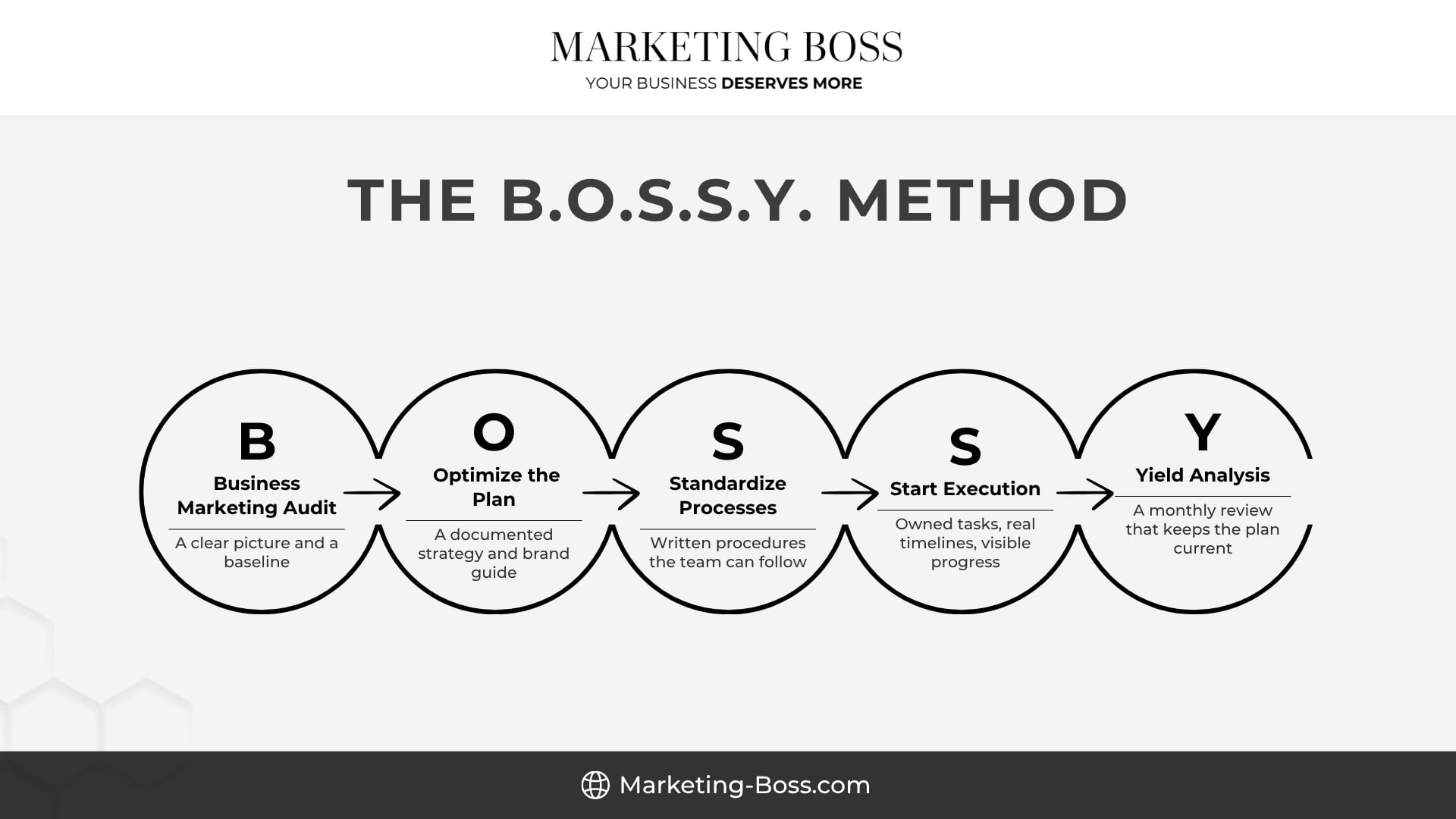
The B.O.S.S.Y. Method is the five-step process Marketing Boss uses to build a marketing system for a law firm. B is a business marketing audit that establishes where the firm stands. O optimizes the plan, producing a documented marketing strategy and a refined brand guide. The first S standardizes processes into written procedures the team can follow. The second S starts execution, with owned tasks, real timelines, and visible progress. Y is yield analysis, the monthly review that measures results against the plan and adjusts it.

Every engagement runs through those five steps in that order, because each one gives the next one something to work with. This article walks through all five, what each produces, and what a firm has in hand when the system is running.
What a Law Firm Marketing System Is
A marketing system is the set of decisions, documents, and habits that let a firm market itself the same way twice. It holds the plan, the people responsible, the procedures, and the rhythm of review. Once those four things exist together, marketing becomes something the firm can direct rather than something it produces in bursts.
The useful part for a law firm owner is that a system is legible. Someone can look at it, understand it in a few minutes, and say what it will do next month. That is a higher standard than most marketing gets, and it is reachable, which is the point of writing this down.
It also means marketing keeps running while the owner is in trial. The plan is on paper. Tasks have names on them. The reporting arrives whether anyone asked for it.
Marketing Boss works with law firms across the United States. The system looks the same for a solo practice and a twenty-attorney firm. What changes is scale, not shape.
Why We Built the B.O.S.S.Y. Method
Margarita Eberline spent more than twenty-five years in marketing, including time at NBC, Telemundo, and Nielsen, before dedicating the last decade to law firms. She built the method as a sequence because the order is what makes it usable: each step needs something the step before it produces.
So the method is sequential on purpose. You audit before you plan, because a plan built on assumptions has to be rebuilt later. You plan before you standardize, because procedures should serve a strategy. You standardize before you scale execution, so the work holds as it grows. And you review monthly, so the plan keeps up with what the firm is learning.
It is also tactic-agnostic. Marketing Boss has no financial stake in which channel wins, which means the audit can say what it finds and the plan can recommend what the firm actually needs. That independence is the reason the sequence works.
B is for Business Marketing Audit
The work starts with a full review of the firm’s business, marketing, and sales functions. The audit answers one question: what does this firm already have, and what is it producing?
What the audit looks at
- The marketing currently running, channel by channel, and what each one produces.
- The vendors in place, their scope, and how their work connects.
- The numbers available today: inquiries, sources, consultations, signed clients, and spend.
- The intake path, from first contact through the signed engagement letter.
- The follow-up sequence for inquiries that take longer to decide.
- Brand consistency across everything the firm publishes.
- The tools already paid for, including the CRM, and how fully they are used.
What you get from it
Two things. A clear written picture of the firm’s strengths, and a baseline. The baseline matters because everything measured later gets measured against it, so progress becomes visible rather than felt.
The audit produces a written list of what to work on and in what order, so the plan that follows is built on what the firm actually has.
The questions the audit asks
The audit is a conversation before it is a document, and these are the questions that shape it.
- What is the firm trying to be in three years, and which practice areas carry that?
- Which cases does the firm want more of, and which does it already do best?
- Where do the strongest inquiries come from today, including referrals?
- What happens in the first ten minutes after someone reaches out?
- Who touches marketing inside the firm, and how much of their week does it take?
- Which vendors are in place, what does each one own, and how do they hand work to each other?
- What can the firm see in its own numbers right now, without asking anyone?
Those answers get written up rather than discussed and set aside. The write-up becomes the first shared reference point, and it is often the first time a firm has seen its whole marketing effort described in one place. It also gives every partner the same document to work from.
O is for Optimize the Marketing Plan
The audit turns into a documented strategy. This is the step that produces the plan, and the plan is the document a firm references all year.
Optimizing here means choosing. Which practice areas the growth comes from, which channels carry which job, what each one is responsible for producing, and what the whole effort is meant to cost. Written down, those choices become decisions the firm can revisit rather than opinions the firm can argue about.
There is a practical test for whether a plan is finished. Hand it to a new hire on their first morning. If they understand the firm’s marketing by lunch, the plan is doing its job.
What goes into a law firm marketing plan
- The growth goal for the year, stated in signed clients or revenue.
- The practice areas the growth comes from, and roughly in what proportion.
- A description of the client the firm wants more of, specific enough that a vendor would recognize one.
- The channels in use, and what each one is responsible for producing.
- The intake path, with response time expectations named.
- The follow-up cadence for inquiries that take longer to decide.
- Who owns each channel, each vendor relationship, and the plan itself.
- The measurement set, meaning which numbers get reviewed monthly and where they come from.
- The review rhythm, meaning when the standing meeting happens and who attends.
A plan covering those nine elements usually runs somewhere between eight and twenty pages. It is a working document, referenced during the year and rewritten at the end of it.
When a firm has more than one practice area
Multi-practice firms get one plan with clear proportions inside it. The plan names which areas are growing, which are steady, and roughly how the effort splits between them, so a decision about budget stops being a debate about whose area matters more.
That split is usually easier to set than firms expect, because it follows from the goal. If the growth target sits in one practice area, the plan says so, and the other areas get a maintenance level of support that is defined rather than assumed. Everyone knows what they are getting and why, which is what makes the plan hold through the year.
It also gives vendors something concrete to work from. A search vendor building around a named priority area produces different work than one building around the firm in general, and the difference shows up in the quality of the inquiries.
The brand guide
Alongside the plan, this step refines the brand guide, which keeps the firm looking and sounding like itself across every vendor who touches it. Once three or four providers are producing work in the firm’s name, a brand guide is what holds the whole thing together as one voice.
S is for Standardize Processes
With the strategy set, best practices get documented and turned into procedures, written together with the firm’s team and its vendors. Standardizing is what makes every other investment in the marketing hold its value.
Standard operating procedures for a law firm’s marketing are usually short. A page describing how a new inquiry moves from the first ring to the signed engagement letter. The follow-up cadence, written out. Coverage plans, so a vacation is a scheduled handoff. A shared location where campaign assets live. Reporting formats and approval paths, so work moves at a predictable pace.
Documentation also makes good work teachable. When someone on intake is noticeably strong, writing down what that person does turns a good hire into a training program, and the next hire starts closer to that standard.
What gets documented
- The intake path and the handoffs inside it.
- Response time expectations, including after-hours coverage.
- The follow-up sequence, with the number of touches and the timing.
- Coverage plans for vacations and busy stretches.
- Where assets live and how they get requested.
- Reporting formats and the monthly calendar around them.
- Approval paths, so work keeps moving.
What a documented intake path looks like
The intake path is the procedure worth writing first, because it touches every inquiry the firm pays to generate. A documented one reads as a sequence of moments, each with an owner and a timeframe.
An inquiry arrives by phone, by form, by chat, or through a referral. It lands in one place where someone is watching. A named person responds inside the window the firm has set, and a second person is named for after hours and weekends. The first conversation follows a shape the team has practiced, so every caller leaves knowing what happens next and when. The inquiry gets logged in the CRM with its source attached, which is what makes the reporting possible later. If the caller is a fit, the consultation gets booked while they are still on the phone. If they need time, the follow-up sequence starts on its own schedule rather than waiting for someone to remember.
Written out, that is about a page. What it produces is consistency, which means the firm can look at a month of inquiries and trust the pattern it sees. It also means a new hire can learn intake in an afternoon rather than by watching someone for six weeks.
S is for Start Execution and Monitoring
The plan goes into motion with clear task ownership, defined timelines, and visible progress in a project management system. This is where a strategy becomes work that ships.
Every piece gets a name attached to it. Not a company name, a person. Someone owns the website. Someone owns paid search. Someone owns intake follow-up. And someone owns the whole thing, accountable for signed clients rather than for one slice of the work.
That last role is what Marketing Boss provides: the senior direction some firms call a fractional CMO, paired with a dedicated project manager who keeps the work moving between meetings. The firm keeps its vendors. What it gains is one person above them, holding everything to the same outcome, and one person making sure the calendar advances.
The effect shows up quickly. Vendors know who to report to. Requests land in one place. Work that used to sit between two providers now has an owner, and the owner has a due date.
What a fractional CMO actually is
CMO stands for Chief Marketing Officer. In a company large enough to have one, that is the executive who owns marketing: the strategy, the budget, the team, the vendors, and the number the whole effort gets judged on. It is a leadership role rather than a hands-on production role. The CMO decides what gets done and why, and specialists do the work.
Fractional means a firm gets that role part-time, on a retainer, rather than hiring a full-time executive. The decisions still need someone senior making them, and the fractional model is how a firm gets that without carrying a full executive salary.
For a law firm, it means one person setting the plan, deciding which channels carry which job, holding the vendors to a single outcome, reading the numbers, and answering for whether the marketing produced signed clients. A marketing leader without a marketing department.
How vendor oversight works day to day
Firms that arrive with vendors in place keep them. Oversight means those providers now have one point of contact, a shared calendar, and a single definition of what success looks like.
In practice, that is a standing check-in with each vendor, a shared view of what is in flight, and a monthly scorecard tied to the plan rather than to the vendor’s own preferred metric. Requests from the firm route through one place instead of four inboxes. Work that used to sit between two providers, each assuming the other had it, now has a name and a due date.
Because Marketing Boss is tactic agnostic, that oversight stays honest. There is no incentive to route budget toward a service the team sells, which means a vendor doing good work gets protected, and a channel that has run its course gets an actual conversation. Firms that need a provider they do not have yet can draw from a vetted network rather than starting a search from scratch.
Y is for Yield Analysis and Adjust
Results get measured against the goals in the plan monthly, and the plan gets adjusted accordingly. This is the step that keeps the system current, and it is the reason the method compounds understanding over time.
What a monthly marketing report includes
- Inquiries received, broken out by source.
- Consultations booked, and how many showed up.
- Signed clients, attributed back to source wherever attribution holds.
- Spend by channel for the period.
- Average response time to a new inquiry.
- What was produced or launched during the month.
- What is planned for the month ahead.
- A short written note from whoever owns the marketing, in plain language, saying what they make of it.
That last line carries more weight than the rest of the page. A single honest paragraph interpreting the month is what turns a report into a decision. Rankings and impressions belong in the working file of whoever runs the channel, where they are genuinely useful. The owner’s monthly read stays focused on the numbers that connect to signed cases.
Call tracking is usually what makes source attribution possible in the first place, and Marketing Boss has written a full walkthrough of that setup separately.
The monthly review
The report feeds a standing meeting: forty-five minutes, same people, same agenda, on the calendar in advance. Fifteen minutes on what the numbers did. Ten on what actually went out. Ten on what is planned next. Ten on what needs a decision from the owner.
Holding it every month builds a record, and the record is where the value lives. After three of them, patterns appear that a single month would hide. Seasonality becomes visible. A channel that is steadily improving gets protected. Decisions start getting made against the trend.
What the first few reviews tend to surface
The first review sets the baseline in motion. The second usually produces the first real comparison, and the third is where firms start seeing something they could not see before.
Common early findings are practical ones. A source that produces fewer inquiries but a much higher share of signed cases. A month where response times improved and the consultation rate moved with them. A practice area quietly outperforming the one getting most of the attention. None of those are visible in a single month, and all of them change where the next dollar goes.
That is the compounding part of the method. Each review adds to a record, and the record is what lets a firm make decisions against the trend rather than against the most recent invoice.
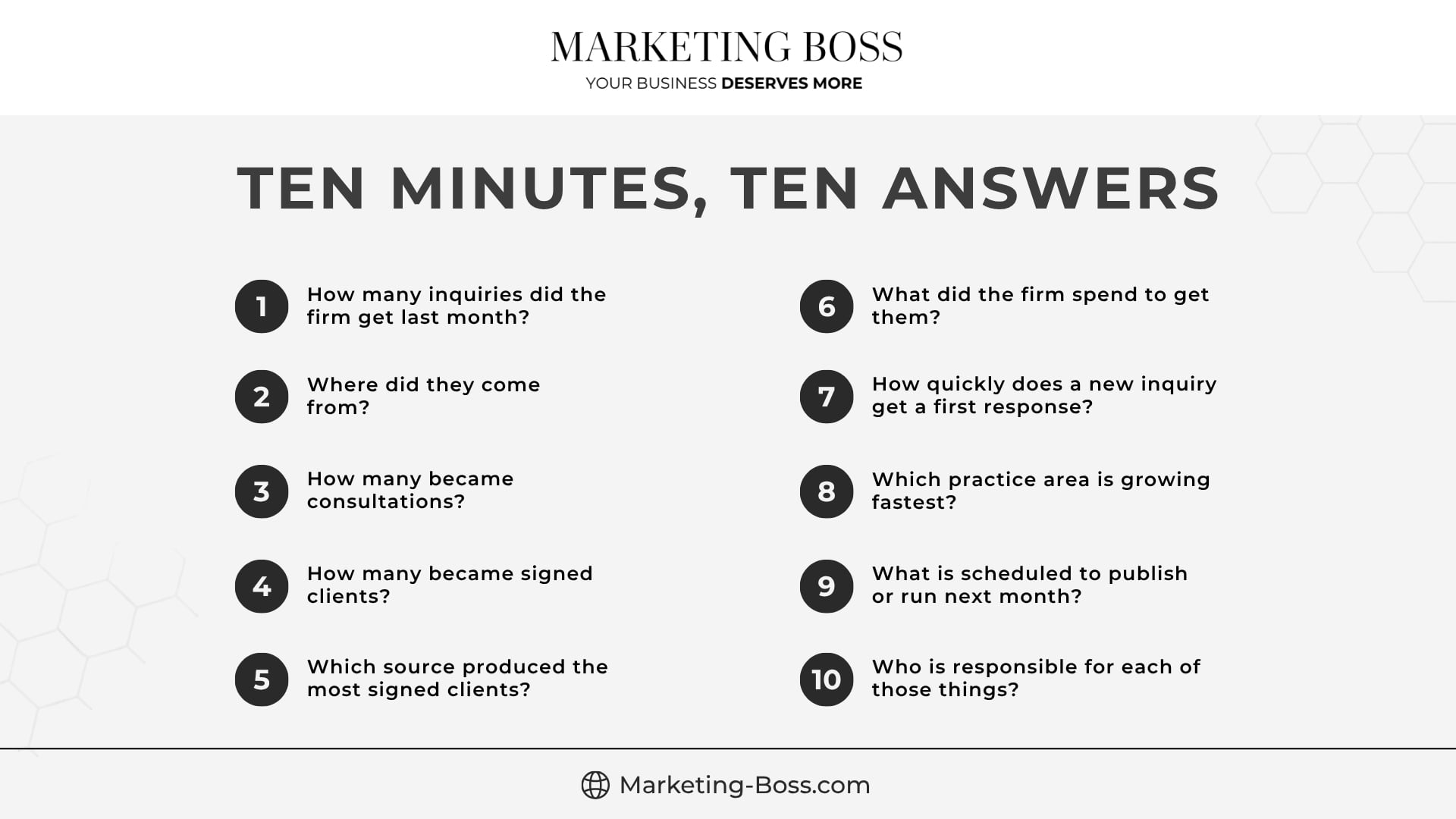
Those ten answers are the practical measure of whether the system is running. In a firm with the B.O.S.S.Y. Method in place, an owner can work through all ten in about ten minutes, on their own, from the reporting they already receive.
The Four Documents Every Client Keeps
The method produces four documents, and every Marketing Boss client keeps them. Together they are the written record of how a firm markets itself, and they stay with the firm.
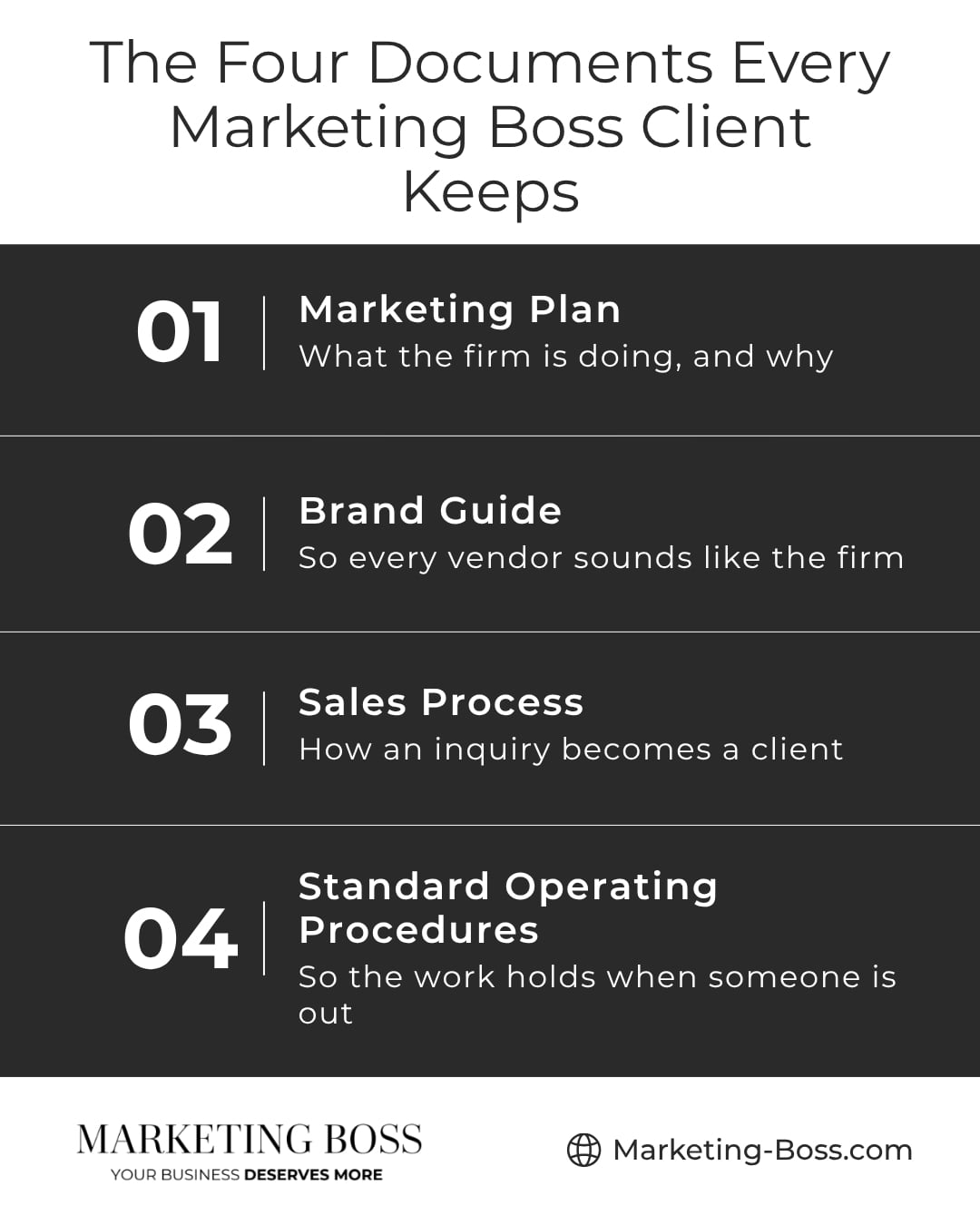
These are the documents a firm hands to a new marketing coordinator, a new intake hire, or a new vendor. They are also what makes the difference between a strategy that lives with one person and a system the firm owns.
Who You Work With
The method runs on a team rather than a single consultant, and the shape of that team is part of why the sequence holds.
A fractional CMO, meaning a Chief Marketing Officer retained part-time, provides the senior direction: the audit, the plan, the calls on which channels carry which job, and accountability for signed clients. A dedicated project manager keeps the work advancing between meetings, which is the difference between a strategy that ships and one that gets admired. Specialized coaches support the sales and intake side, including the Connect Convert training. And a vetted vendor network is available when a firm needs a provider it does not have, so the search starts from a short list of people the team has worked with.
For the firm, the practical effect is that marketing has a leader and a coordinator without carrying two full-time salaries, and the owner has one person to call.
Why the Method Comes From Margarita Eberline
Marketing Boss works with law firms, and has for the past decade. That focus is a choice Margarita made deliberately, and it is worth saying why, because it explains the shape of the method.
Legal is a category where the person choosing the marketing vendor is also the person in trial on Thursday. Marketing lands on someone who has a caseload, a payroll, and roughly no spare hours, which means a framework only works if it survives a busy month. Building for that specific reader is a different discipline than building for a marketing department, and it is the reason B.O.S.S.Y. is five steps rather than a longer framework.
The rigor behind those five steps comes from where she trained. Twenty-five years in marketing, including NBC, Telemundo, Columbia Pictures, and The Nielsen Company. Those are organizations that do not run marketing on instinct. Research comes first, the plan is written, ownership is named, and results get reviewed on a schedule whether or not anyone is worried about them. The method is that discipline, translated into something a law firm can actually run.
The rest of the record backs it up. She wrote Connect Convert, the sales and conversion guide built for law firm teams, and she teaches the program that goes with it. She hosts The Care Sandwich Podcast. She speaks nationally on law firm growth, including at ClioCon and the WILBYBETTY Women and Leadership Conference, and she has taught marketing in Singapore, Peru, the Philippines, and across Africa. Law.com named her among the female founders of legal tech in 2024. She studied History and Rhetoric at UC Berkeley as an Emma L. Bowen Foundation scholar, which turns out to be a useful pair of subjects for a job that is mostly evidence and persuasion.
The line she comes back to is the one that explains the method best.
“Marketing doesn’t have to be overwhelming. It just needs to be intentional.”
Margarita Eberline, Founder and CEO, Marketing Boss
Firms who work with Marketing Boss work with her directly. The fractional CMO role on an engagement is hers, supported by the project manager, the coaches, and the vendor network described above.
Where Connect Convert Fits
The five steps build the structure. Connect Convert is about what happens inside it, in the specific minutes when a prospective client is on the phone.
Connect Convert is the sales and intake training Marketing Boss built for law firms, and it also exists as a book by Margarita Eberline. It combines marketing strategy with sales training and neurolinguistic programming, so an intake team can connect with a caller, understand what they need, and guide the conversation toward a decision. It improves conversion on every inquiry the firm already generates, which is why it sits alongside the structural work rather than after it.
In method terms, Connect Convert fills in the intake section of the plan and the intake procedures in the standard operating procedures. The structure gives the team a defined path. The training gives them the skill to walk it well.
Who Owns Your Website, Accounts, and Data
One thing the audit confirms early, and it is worth knowing while everything is calm. In a healthy setup, the firm holds its domain registration, its website and hosting, its Google Business Profile, its advertising accounts, its analytics property, its CRM data, and its call recordings. Vendors are granted access to those assets.
That arrangement keeps the firm free to add a provider, change one, or bring something in-house while keeping its own history. Good vendors expect the question and answer it in a sentence.
The firms that handle this best keep a short central list: the asset, its platform, who holds the admin seat, and who at the firm can get in. Fifteen minutes to write. Marketing Boss keeps that record current for its clients as part of vendor oversight.
What Changes Once the System Is Running
Three things change once the system is running.
Marketing stops taking up mental space. The plan is written, someone owns it, the report arrives, and the meeting is on the calendar. For an attorney carrying a full caseload, that alone is worth a great deal.
Decisions get faster. A vendor pitch arrives, and there is an obvious way to evaluate it, which is whether it serves the plan. New opportunities get assessed in minutes.
And growth becomes something the firm can plan around. Once you know roughly what a month of marketing produces, you can hire against it, take on space against it, and set goals the rest of the firm can believe. Predictability is the real product, and it is what makes marketing feel like a business function.
Firms at Every Stage
The method scales, and the entry point differs depending on where a firm is.
A newer or smaller firm gains the most from the plan and the procedures. With one or two channels running, the highest return comes from writing down what the firm is doing and how an inquiry gets handled. Reporting can stay simple.
A growing firm with several vendors gains the most from execution and yield analysis. The channels are running, and the work is happening. Adding one person above the vendor layer, plus a monthly report the owner can read, changes the return on everything already in motion.
An established firm, often multi-office or multi-practice area, gains the most from standardization and rhythm. The individual pieces work well. Consistency across locations and a steady review cadence is what keeps a larger operation pointed the same way.
Marketing Boss works with firms at all three stages. The starting step differs. The destination is the same.
What to Ask Before Adding a New Channel
Once the system is running, one decision comes up regularly: whether to add something new. A vendor calls with a pitch. A colleague mentions a channel working well for them. A conference session makes something sound urgent.
A firm with a plan has a short set of questions ready for exactly that moment.
- Which goal in the plan does this serve?
- What is it responsible for producing, and by when? Name the number before the work starts.
- Who will own it?
- What does the firm need to provide? Photos, video, approvals, an attorney’s time. That cost is real and worth pricing up front.
- How will we know in ninety days? Decide the checkpoint and the measure at the start.
- What comes off the plate to make room? Marketing capacity inside a firm is finite, and trading deliberately keeps the plan focused.
Firms that run new opportunities through those six questions add channels less often and stay with them longer, which is usually the better outcome. It also shortens vendor conversations, because you are checking a fit rather than evaluating a pitch. Good providers appreciate the difference.
Keeping the System Running Through a Busy Quarter
Every law firm has quarters where the practice takes over. A trial runs long, a partner is out, the caseload spikes. A system is built to carry those stretches, and a few habits make it easy.
Keep the monthly review, even a short version. Twenty minutes preserves the record and keeps the thread continuous.
Protect the recurring work first. Publishing, follow-up sequences, and reporting compound quietly, so they stay running while new initiatives wait.
Batch anything that needs an attorney on camera or on the record. One hour of filming can cover a quarter of content, and firms that batch stay ahead of their own calendars.
Let the procedures carry the load. This is the moment standardization pays for itself, because the team keeps the work at standard while the owner is heads down.
And keep a short list of what got deferred. It makes the return simple and keeps every deferred item accounted for.
Marketing Boss handles this stretch directly for its clients, which is part of the point of a dedicated project manager. The work keeps moving between meetings.
What Law Firms Say About Working With Us
The method is easier to picture in the words of the people who have been through it. These are verified Google reviews, part of a 4.9-star rating.
“We hired Marketing Boss to work with our intake and sales team, and it’s been a great decision. We implemented their Connect Convert program and saw immediate improvements … in overall confidence and consistency. Their approach is thoughtful, clear, and results-driven.”
Milica Kilibarda, verified Google review
“Her Connect Convert methodology teaches teams how to connect with leads instantly, qualify better prospects, and convert them into signed cases with measurable outcomes. If you want to turn more of your marketing into actual revenue and build a predictable intake process, Margarita is the expert to work with.”
K’Lee Terrazas, verified Google review
“Margarita and her team are committed professionals who really love what they do. She is constantly looking for ways to improve her services in this day of constant change. She is on top of it.”
Arnice Foster, verified Google review
Ready to Build Yours?
The B.O.S.S.Y. Method starts with the audit, and the audit starts with a conversation. Marketing Boss will look at what your firm already has in place, tell you plainly which step you are ready for, and lay out what the build would involve. There is no cost to starting, and no pressure in it.
Fractional CMO leadership, a dedicated project manager, Connect Convert training, vendor oversight, and reporting that tracks signed clients by source all come with the method. You can see the full picture on our marketing services page.
Call 404-751-3594 today, or visit marketing-boss.com to book your strategy conversation.
Frequently Asked Questions
It is the five-step process Marketing Boss uses to build a marketing system for a law firm. B is a business marketing audit that establishes where the firm stands. O optimizes the plan, producing a documented marketing strategy and a refined brand guide. The first S standardizes processes into written procedures. The second S starts execution with owned tasks and real timelines. Y is yield analysis, the monthly review that measures results against the plan and adjusts it. Every Marketing Boss engagement runs through all five, in that order.
It is the set of decisions, documents, and habits that let a firm market itself the same way twice: a written plan, a named owner for every moving part, documented procedures, and a standing monthly review. A firm with all four in place can say what its marketing will produce next month, which is the practical measure of a system.
The growth goal stated in signed clients or revenue, the practice areas the growth comes from, a description of the ideal client, the channels in use and what each is responsible for, the intake path with response time expectations, the follow-up cadence, who owns each piece, the numbers reviewed monthly, and when the standing review happens. A plan covering those nine elements usually runs eight to twenty pages.
Inquiries by source, consultations booked and show rate, signed clients attributed to source, spend by channel, average response time to a new inquiry, what was produced during the month, what is planned next, and a short written note in plain language from whoever owns the marketing. That last piece is what turns a report into a decision.
The firm. Domain registration, website and hosting, Google Business Profile, advertising accounts, analytics, CRM data, and call recordings sit in the firm’s name, with vendors granted access. Keeping a short central list of each asset, its platform, and who at the firm can reach it takes about fifteen minutes and keeps the firm free to change providers while holding onto its own history.
The audit and the documented plan come first and move quickly. Standardized procedures and a reliable reporting rhythm build over the following months, because they get tested against real weeks rather than designed in the abstract. The change in how marketing is managed shows up before the numbers finish moving, which is a good early signal.
CMO stands for Chief Marketing Officer, the executive who owns marketing strategy, budget, vendors, and the results the whole effort gets judged on. It is a leadership role rather than a production role. Fractional means a firm retains that role part-time rather than hiring a full-time executive, so the decisions get someone senior without the firm carrying a full executive salary. For a law firm, a fractional CMO sets the plan, decides which channels carry which job, holds the vendors to one outcome, reads the numbers, and answers for whether the marketing produced signed clients.
Strategy, ownership, and decision-making work best close to the firm, because they depend on knowing the practice. Channel execution, meaning the hands-on production of search, ads, web development, and creative, is usually better bought than built. The role in between, someone senior who directs the specialists and stays accountable for signed clients, can go either way, and many firms bring it in on a fractional basis.
Twenty-five years in marketing, including NBC, Telemundo, Columbia Pictures, and The Nielsen Company, followed by a decade working exclusively with law firms. She created the B.O.S.S.Y. Method, wrote Connect Convert, and hosts The Care Sandwich Podcast. She speaks nationally on law firm growth, including at ClioCon and the WILBYBETTY Women and Leadership Conference, and Law.com named her among the female founders of legal tech in 2024.
Review it monthly and rewrite it annually. The monthly review adjusts tactics against what the numbers are showing. The annual rewrite revisits the goal, the practice area mix, and the channel roles, usually alongside the firm’s own budgeting cycle.

Written By Margarita Eberline
At Marketing Boss, I help law firms like yours simplify, systemize, and scale their marketing efforts. Early in my career, I took on a sales role at Telemundo Atlanta, where I connected with local attorneys and was inspired to launch my own full-service advertising agency. Over the years, I realized that the traditional agency business model was fundamentally incompatible with my desire to remain fully tactic-agnostic and data-driven in my recommendations to clients. This led me to launch Marketing Boss, where I could focus on creating unbiased strategies that serve my clients’ needs.
Insights from the Marketing Boss Team


Your Firm Deserves Marketing That Works

Your Firm Deserves Marketing That Works