


Table of Contents

Table of Contents
TL;DR
Marketing attribution connects a signed case back to the marketing that brought it in. For a law firm, the data to do it usually already exists. It just lives in five places: your website and analytics, your call tracking, your lead capture forms, your case management software, and the advertising platforms themselves.

Marketing Boss runs a complimentary 30-day attribution cleanup for qualifying law firms. We review all five layers, confirm the handoffs between them, and give you back a clear read on which channels are producing signed cases.
What Attribution Means for a Law Firm
Attribution answers one question: which marketing got this case signed? Every other marketing question sits downstream of that one. Where to put more budget, which vendor to keep, which practice area to push, whether the new campaign worked.
For most businesses, the path is short. Someone clicks an ad, buys something, and the platform records the sale. A law firm has a longer and more human path. Someone searches, reads a page, calls, speaks to an intake coordinator, books a consultation, thinks it over, and signs two weeks later. The marketing that started it and the moment that closed it are separated by weeks and by three or four different systems.
Two words get used interchangeably here, and they mean different things. Tracking is recording that something happened, which each platform does well on its own. Attribution is assigning that event to a cause and following it through to an outcome. A firm can have thorough tracking and partial attribution at the same time, because tracking is what each vendor installs and attribution is what connects their work together.
The distinction is practical. If tracking is the gap, the fix is usually adding something. If attribution is the gap, the fix is connecting things that already exist, which is faster and doesn’t add another tool to the stack.
Where Your Case Data Already Lives
The pieces sit across five layers, and each one holds part of the answer.
Website and analytics
This layer records what happens before anyone contacts you. Google Analytics 4 tracks which pages people visit and how they arrived. Google Tag Manager decides what gets tracked and when. Your site holds the landing pages and the forms.
If GA4 is on your site, the thing to confirm is whether conversion tracking fires on the actions that matter to your firm, meaning form submissions, phone clicks, chat starts, and intake completions rather than page views alone. That’s a setting, not a rebuild.
Call tracking
Law firms run on the phone, so this layer carries more weight here than in most industries. Call tracking software such as CallRail assigns numbers to individual sources, and dynamic number insertion swaps the number displayed on your site based on how the visitor arrived, so the source travels with the call.
The practical check is how many numbers are in play and what each is mapped to. A firm running search, paid search, a Google Business Profile listing, and print will want those separated, because the value of the layer is being able to tell them apart.
Lead capture
Between the website and the case file sits the layer that catches the inquiry: GoHighLevel, contact forms, live chat, and intake forms. This is where a visitor becomes a named person with contact details.
A main contact form, a practice area form, a chat widget, and a phone line are often added at different times by different people, and each one needs to carry source data forward rather than simply delivering a name and a number to an inbox.
Case management
This is the system of record and, for attribution, the finish line. Clio, Lawmatics, Filevine, Lead Docket, Litify, MyCase, SmartAdvocate, PracticePanther, Needles and CASEpeer all live here.
Case management knows what no marketing platform knows, which is whether the matter was signed. Marketing software can tell you a form was filled out. Only this layer can tell you a client came aboard.
These systems differ in how they handle it. Some, like Lawmatics and Lead Docket, were built with intake in mind and carry source fields natively. Others are built around matter management first, with source handled through a custom field or an integration. One detail worth checking either way: whether the source survives the step where a lead becomes a matter. In several systems, those are separate records, and a field populated on the lead doesn’t always carry across.
Advertising and marketing channels
The last layer is the platforms themselves: Google Ads, Local Services Ads, Meta, Microsoft Ads, organic search, your Google Business Profile, and email.
Local Services Ads deserve a mention for law firms, because leads arrive inside Google’s own interface rather than on your site, which means they can bypass the website layer entirely. Google Business Profile has a similar wrinkle, since calls placed straight from a listing never touch the website. Both are straightforward to connect and easy to miss, because nothing looks wrong until you go looking.
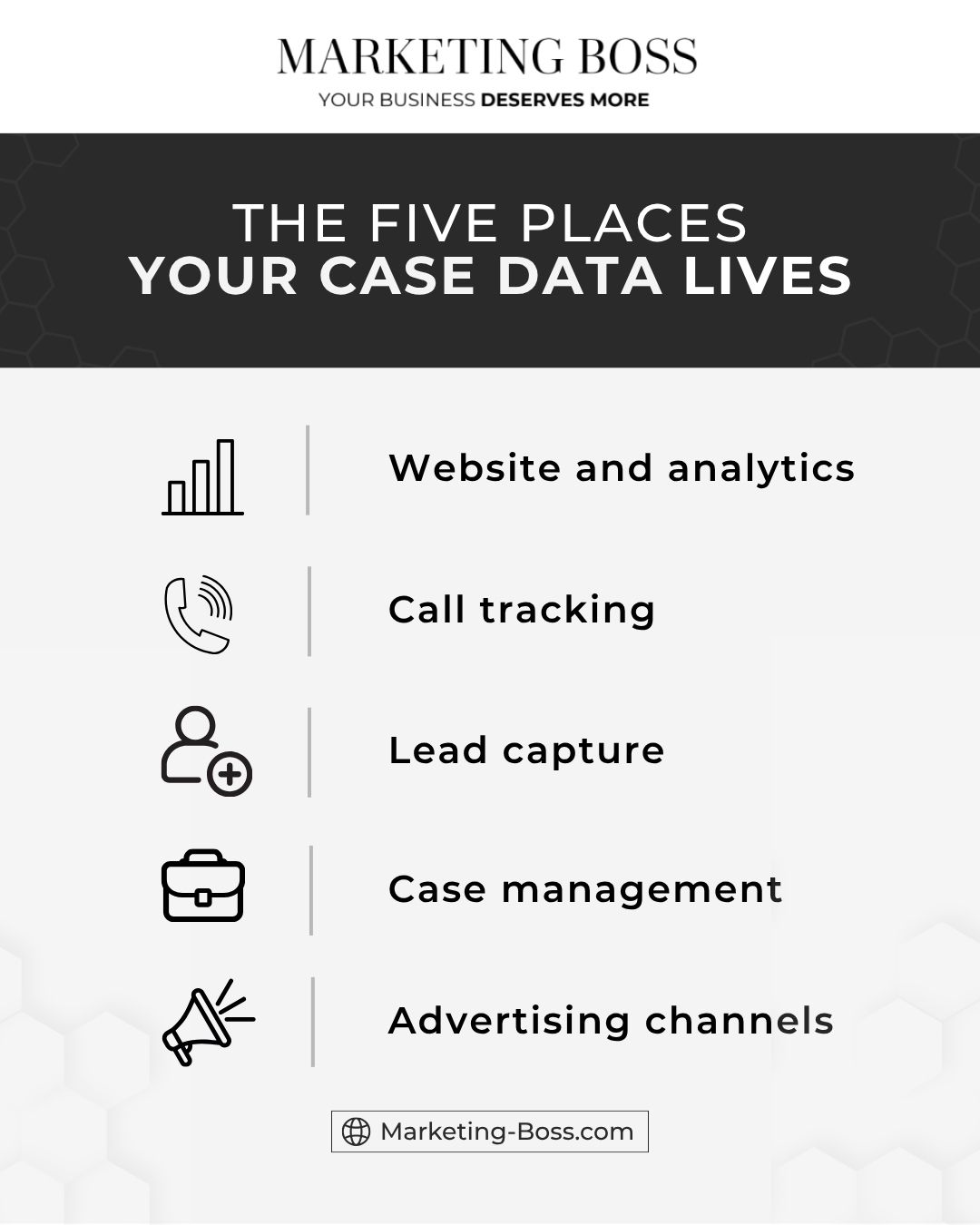
One thing worth saying about these five: they were almost never set up together. The analytics went in when the site was built, the call tracking came with an ad campaign, the forms were added one at a time, and the case management system was chosen by the practice rather than by marketing. Each decision made sense on its own. The chain between them is the part nobody was assigned.
Why the Platform Totals Never Match
Add up the conversions reported by Google Ads, Meta, and your call tracking, and the total comes out higher than the number of people who actually contacted the firm.
That’s working as designed. Each platform answers its own question, which is whether it played a part. If someone sees a Meta ad on Monday, searches your firm by name on Wednesday, and clicks a Google ad, both platforms count that person, because both were involved. Neither is wrong. They’re reporting independently, with no visibility into each other.
Attribution reconciles them. Once each inquiry carries a source into one shared system, the firm gets a single count instead of several overlapping ones, and the comparison between channels becomes an actual comparison.
The Handoffs Worth Confirming
Attribution holds or slips at the handoffs, meaning the points where one system passes information to the next. There are four.
From the channel into the website, the source should be captured on arrival and held through the visit rather than dropped at the first page change. From the website into the inquiry, the source should ride along whether the inquiry arrives by form, by chat, or by phone. From the inquiry into case management, the source needs to reach the matter record. And from case management back into reporting, the signed outcome needs to travel back to the source, which is what closes the loop.
Two of the four are usually in good shape already, because they sit inside one vendor’s work. The third and fourth cross a boundary, sitting between a marketing provider and a practice management provider. Neither is difficult. They need a person whose job covers both sides of the line.
What You Get Once It’s Connected
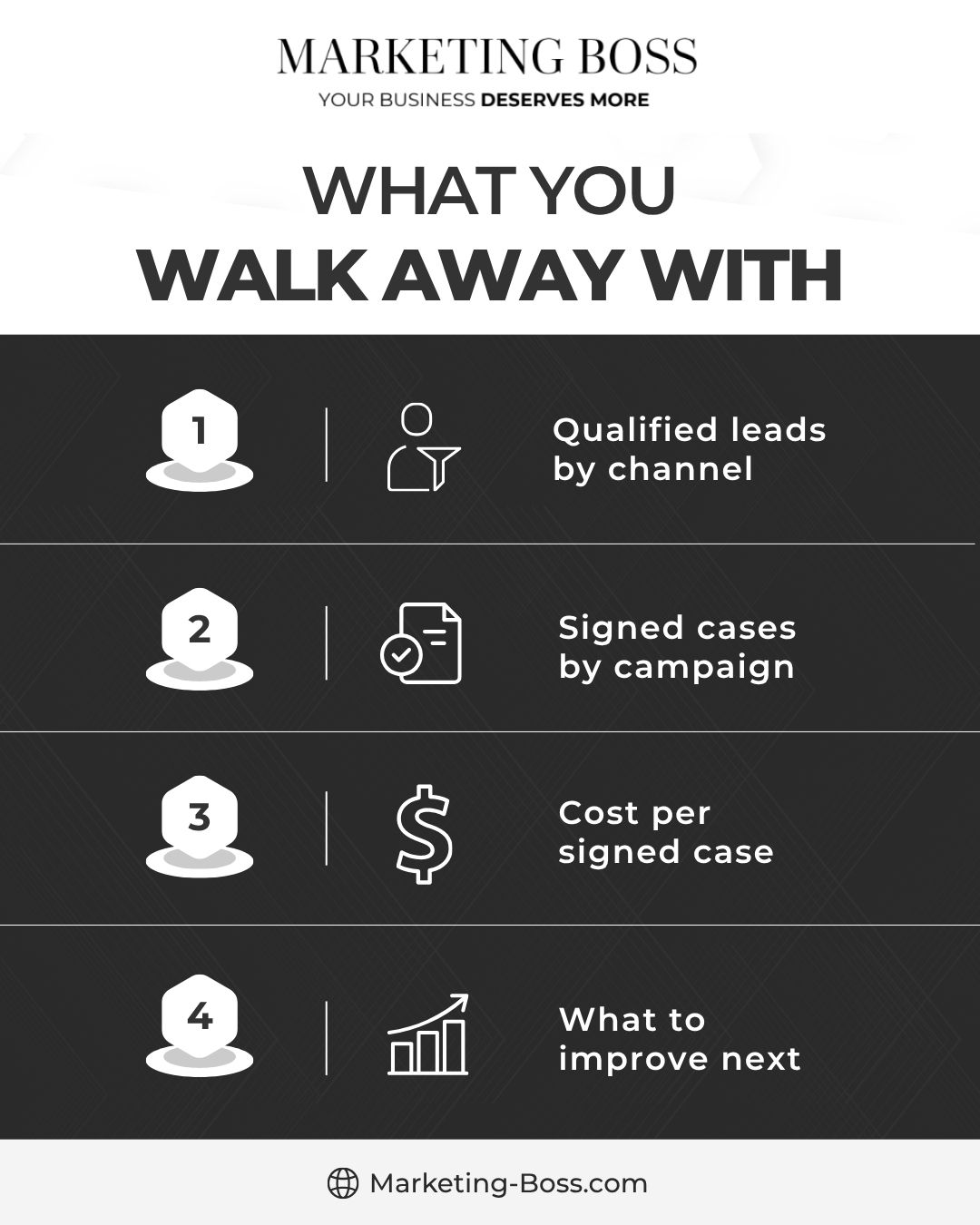
Four answers become available that were not before.
Qualified inquiries by channel rather than raw inquiries by channel, which matters once a firm is spending real money, because two sources can deliver the same number of calls and a very different number of cases. Signed cases by campaign, which is the number that decides budget. Cost per signed case by source, which reorders things, since a channel with expensive clicks can produce the cheapest cases if the people it sends are ready to hire. And a clear view of where inquiries slip between systems, with the fixes listed in the order worth doing them.
The same connection settles a question that comes up in nearly every partner meeting, which is whether referrals should count as a marketing source. Once referral inquiries are logged with a source like any other, they sit next to paid channels and get weighed on the same terms.
None of it requires new marketing. It comes from connecting what the firm already runs.
What the Cleanup Covers
The review runs across thirty days and covers all five layers: GA4, Tag Manager and conversion tracking on the website; CallRail and dynamic number insertion on calls; GoHighLevel, forms, chat and intake on lead capture; whichever case management system your firm runs; and Google Ads, Local Services Ads, Meta, Microsoft Ads, organic search, Google Business Profile and email across advertising.
Thirty days rather than an afternoon, because a test submission proves a form works and a month of real inquiries proves the chain holds under the way your firm actually operates. The calls that come in after hours, the referrals logged by hand, the person who fills out a form on a Saturday and calls on Tuesday. Those reveal whether the connection is solid, and they only show up in live traffic.
It also runs alongside the practice rather than interrupting it. Nothing gets rebuilt, no new software gets bought, and your vendors keep running what they run. What the team provides is access to the accounts at the permission level needed to review configuration, one conversation early on about how inquiries move through the firm, and one at the end to walk the findings.
What the First Connected Report Looks Like
The view a firm gets is narrower than a full marketing report and more useful for the decisions that come up.
Inquiries by source for the period, then consultations booked from each source, then matters signed from each source, then spend. Four columns, one row per channel, and the ability to read across a row. That’s the part that changes conversations. A channel that sent forty inquiries and signed two sits next to a channel that sent twelve and signed five, and the comparison makes itself.
A second view is worth having alongside it, which is time to signature by source. Some channels bring people who are ready now. Others bring people who are researching and will decide in six weeks. Knowing which is which changes how you read a slow month.
Where Judgment Still Matters
Clean attribution gives a firm better inputs. It doesn’t make the decision.
It reports the last clear source and the path around it. It can’t weigh the billboard a prospect passed for a year, the colleague who mentioned your name, or the reputation that made someone pick your firm from three results. Case value sits outside it too, since a channel signing fewer matters at higher value can be worth more than one signing many small ones.
So attribution is evidence rather than verdict. It narrows the conversation to what can be measured, which leaves more room for the judgment that can’t be.
A Good Stretch of the Year to Do It
Thirty days started now finishes while the year is still open, which means the numbers are confirmed before anyone sits down to build next year’s plan.
Budget conversations, vendor renewals, and practice area decisions all move faster when the figures behind them have already been checked. Doing this first means the planning work gets to be about choices.
If Your Firm Already Has a Marketing Team
The cleanup supports whoever is running marketing rather than sitting on top of them.
For an in-house marketing lead, it supplies the measurement layer their reporting depends on and handles the configuration work that tends to get pushed down the list because it’s technical and sits between two vendors. For an agency relationship, it gives both sides a shared scoreboard, and an agency doing good work benefits when their results finally connect to signed matters instead of stopping at form submissions.
Where This Sits in the B.O.S.S.Y. Method
Every Marketing Boss engagement runs through five steps: a business marketing audit, optimizing the plan, standardizing processes, starting execution, and yield analysis.
The attribution cleanup is the data layer underneath the first step and the last one. The audit asks what the firm has and what it’s producing, and that answer is only as good as the numbers behind it. Yield analysis reviews results against the plan monthly, and that review needs a source of truth.
What Happens After the Cleanup
The cleanup stands on its own, and plenty of firms take the findings and handle the rest themselves.
For firms that want the work carried out, there are two offers. CMO Leadership gives a firm a dedicated marketing team led by a fractional Chief Marketing Officer, with a project manager, vendor oversight, and monthly reporting built around the numbers the cleanup just confirmed. Sales Training, through the Connect Convert program, works the other side of the inquiry, giving an intake team the skills to convert more of the leads the marketing already brings in.
Who It’s For
A few situations make it especially worth doing now. A firm spending across more than one channel that wants to know which one is carrying the result. A firm that changed marketing providers and inherited a setup nobody documented. A firm that recently moved case management systems, since that migration touches the handoff most likely to need attention. And a firm about to raise its marketing investment, because scaling a channel multiplies whatever the measurement is doing.
Marketing Boss works with law firms across the United States, exclusively, which is why the review covers legal software rather than generic business tools.
What Law Firms Say About Working With Us
These are verified Google reviews, part of a 4.9-star rating.
“We hired Marketing Boss to work with our intake and sales team, and it’s been a great decision. We implemented their Connect Convert program and saw immediate improvements … in overall confidence and consistency. Their approach is thoughtful, clear, and results-driven.”
Milica Kilibarda, verified Google review
“Her Connect Convert methodology teaches teams how to connect with leads instantly, qualify better prospects, and convert them into signed cases with measurable outcomes. If you want to turn more of your marketing into actual revenue and build a predictable intake process, Margarita is the expert to work with.”
K’Lee Terrazas, verified Google review
Ready to See Which Marketing Is Getting Your Cases Signed?
The complimentary 30-day attribution cleanup is open to qualifying law firms. We review your website and analytics, your call tracking, your lead capture, your case management system, and your advertising channels, confirm the handoffs between them, and give you back a clear read on what is producing signed cases.
No cost, and no obligation attached to it. If the findings point toward working together, that conversation is there to have. If they point toward a few configuration fixes your current team can make, you’ll have the list.
Apply at marketingbosscmo.com/30-day-attribution-cleanup, or call 404-751-3594 to talk it through first.
Frequently Asked Questions
It’s the practice of connecting a signed case back to the marketing that produced it. For a law firm, the data sits across five systems: website analytics, call tracking, lead capture, case management, and the advertising platforms. Attribution connects those systems so a source travels with an inquiry from the first click or call through to the signed engagement, which lets a firm measure marketing in cases rather than in clicks.
You need the source attached to the inquiry and carried into your case management system, so that when a matter is signed, the outcome can be traced back. If your reporting shows calls and form fills by channel but can’t show signed matters by channel, the chain is connected partway. A 30-day attribution cleanup confirms each handoff and closes the gaps.
Marketing Boss reviews five layers: website and analytics including GA4, Google Tag Manager and conversion tracking; call tracking including CallRail and dynamic number insertion; lead capture including GoHighLevel, contact forms, live chat and intake forms; case management including Clio, Lawmatics, Filevine, Lead Docket, Litify, MyCase, SmartAdvocate, PracticePanther, Needles and CASEpeer; and advertising channels including Google Ads, Local Services Ads, Meta, Microsoft Ads, SEO, Google Business Profile and email. It’s complimentary for qualifying law firms.
It can, and it’s one of the most valuable connections a firm can make. Call tracking knows which marketing produced the call. Case management knows whether the matter was signed. Linking them is what lets a firm report signed cases by source rather than calls by source. The setup varies by which systems a firm runs, and confirming it’s part of the cleanup.
GA4 is the current version of Google Analytics, the free tool that records how people arrive at your website and what they do there. A firm running any online marketing benefits from having it configured properly, with conversion tracking set to fire on the actions that matter such as form submissions and phone clicks. Installed but unconfigured is common, and it’s quick to correct.
The setup work happens quickly. The data becomes useful once enough real inquiries have moved through the connected chain, which is why the cleanup runs across thirty days rather than a single session. Watching actual inquiries travel from source to signed matter is what confirms the connections are holding.

Written By Margarita Eberline
At Marketing Boss, I help law firms like yours simplify, systemize, and scale their marketing efforts. Early in my career, I took on a sales role at Telemundo Atlanta, where I connected with local attorneys and was inspired to launch my own full-service advertising agency. Over the years, I realized that the traditional agency business model was fundamentally incompatible with my desire to remain fully tactic-agnostic and data-driven in my recommendations to clients. This led me to launch Marketing Boss, where I could focus on creating unbiased strategies that serve my clients’ needs.
Insights from the Marketing Boss Team


Your Firm Deserves Marketing That Works

Your Firm Deserves Marketing That Works